Welcome to manteasers.com - Dont forget to bookmark us!
Do Many Men Prefer Women with Larger Breasts?
Do Many Men Prefer Women with Larger Breasts or not? Science research clearly shows that medium-sized, firm breasts are the top choice across cultures for men.
Man Teasers
12/11/20254 min read


In a world obsessed with physical attraction, few topics spark as much curiosity—and controversy—as men's preferences for women's breast size. The question "Why do men prefer women with large tits?" (to borrow the blunt phrasing of many online searches) is often met with simplistic answers: "Because they're men," or "It's just evolutionary." But the reality is far more nuanced. Not all men share this preference, and even among those who do, it's shaped by a complex interplay of biology, evolution, psychology, culture, and personal circumstances.
Scientific studies reveal a fascinating truth: while larger breasts are appealing to many men in certain contexts, the most consistent cross-cultural preference is actually for medium-sized breasts, with firmness and shape often mattering more than sheer volume. Large breasts rank second in many surveys, and small ones third. Yet, the stereotype persists, amplified by media and pornography. In this in-depth exploration, we'll unpack the evidence-based reasons behind these preferences, drawing from evolutionary psychology, cross-cultural research, and sociological insights. By the end, you'll see that attraction isn't a one-size-fits-all phenomenon—pun intended.
The Evolutionary Puzzle: Why Do Humans Have Permanent Breasts?
Humans are unique among primates. In most mammals, breasts enlarge only during pregnancy and lactation, flattening otherwise. But human women have permanently prominent breasts, even when not nursing. This anomaly has puzzled evolutionary biologists for decades.
One leading theory posits that permanent breasts evolved as a sexual signal. As early humans shifted to bipedalism (walking upright), the buttocks—which were a key fertility cue in rear-entry mating among primates—became less visible during face-to-face interactions. Breasts may have "migrated" forward as a mimic of buttocks, signaling fertility and youth from the front.
Another hypothesis links breasts to fat reserves. Larger breasts could indicate better nutritional status and energy stores for pregnancy and lactation in resource-scarce environments. Studies support this: women with larger breasts often have higher estradiol (estrogen) levels mid-cycle, correlating with fertility. Firm, perky breasts signal youth and nulliparity (no prior pregnancies), as breasts sag with age, gravity, and childbearing.
Harvard anthropologist Frank Marlowe proposed that larger breasts sag more noticeably over time, making them an honest cue of age and reproductive history. Men preferring firmer, larger breasts might unconsciously select for younger, more fertile partners.
Yet, evidence is mixed. Breast size doesn't affect milk production quality—small-breasted women lactate just as effectively. Some theorists argue breasts are a "runaway" sexual selection trait, like a peacock's tail: once men found them attractive, women with larger ones had more mating success, amplifying the preference.
During intimacy, breast stimulation releases oxytocin in women, fostering bonding. Men evolved attraction to encourage this pair-bonding, beneficial for offspring survival in our species' long childhoods.
What Do Studies Actually Say About Preferences?
Contrary to popular belief, no universal "big is best" rule exists. A meta-review of studies shows:
Medium-sized breasts are most frequently rated attractive (around 33% in aggregated data), followed by large (24%), very large (19%), and small, lowest.
In cross-cultural surveys (e.g., New Zealand, Samoa, Papua New Guinea), men preferred medium to large over small, but not extra-large.
A 2016 study across Brazil, Cameroon, the Czech Republic, and Namibia found variable size preferences but a unanimous preference for firm, non-ptotic (non-sagging) breasts—supporting firmness as a "residual fertility" cue.
Eye-tracking research confirms men (and women) gaze at breasts, but shape and symmetry often trump size.
Contextual Factors: When Bigger Seems Better
Preferences aren't fixed—they shift with circumstances:
Resource Security: Men in lower socioeconomic groups or who are hungry rate larger breasts (and bodies) higher. A PLoS One study found hungry men preferred significantly larger sizes than satiated ones, viewing them as signals of fat reserves and resource access. Wealthier or food-secure men leaned toward smaller or medium.
Mating Strategy: Men with "unrestricted sociosexuality" (preferring casual sex) favor larger breasts more than those seeking long-term partners. This ties to perceiving larger sizes as cues for short-term mating.
Attitudes Toward Women: Studies link preference for larger breasts to benevolent sexism, objectification, and hostile attitudes. One found men rating very large, the highest often held oppressive beliefs.
Individual Differences: Age, relationship status, and self-perceived attractiveness influence ratings. Men wanting children sometimes prefer larger, associating them with nurturing.
The Powerful Role of Culture and Media
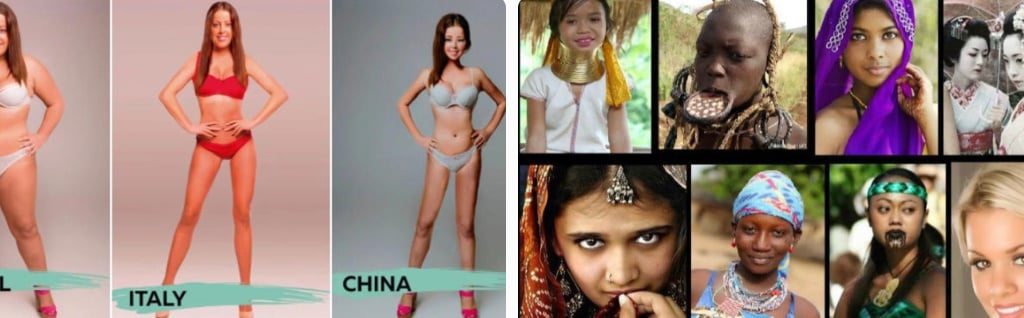
Culture heavily modulates biology. In Western media, large breasts are fetishized—think Playboy, Victoria's Secret, or cosmetic surgery trends. This amplifies preferences in post-industrial societies.
In contrast:
Some African tribes value pendulous breasts as signs of maturity and motherhood.
East Asian ideals often favor smaller, proportionate breasts tied to modesty.
In resource-poor areas, plumper figures (including breasts) signal health.
Globalization spreads Western ideals, but local variations persist. In St. Kitts (Caribbean), men preferred smaller breasts than in the U.S. samples.
Why the Myth Persists—and Why It Matters
The "men love big boobs" trope endures because visible extremes (porn, celebrities) dominate discourse. But most men appreciate a range—attraction involves a person's face, personality, waist-to-hip ratio, and overall proportions.
This preference can harm women: pressure for augmentation, body dissatisfaction, and objectification. Understanding it's not hardwired universality empowers body positivity.
In committed relationships, emotional bonds often override physical ideals. Many men prioritize connection over cup size.
Conclusion: It's Complicated, and That's Okay
Men's attraction to larger breasts stems from evolutionary signals (fertility, youth, resources), psychological factors (mating strategy, attitudes), and cultural amplification. But data shows medium, firm breasts win most often cross-culturally. Preferences vary by hunger, wealth, and worldview.
Ultimately, human attraction defies simple explanations. We're drawn to wholes—bodies, minds, hearts. Whether small, medium, or large, breasts are one facet of diverse beauty. Embrace what makes you feel confident; the right person will too. We at man-teasers know what men like and hire models with what we believe is the most common and sought-after breast size that men like, so we got you covered.

© 2025. All rights reserved.
2608 Westgrove Dr #236, Carrollton, Texas 75006.
Email - info@manteasers.com