Welcome to manteasers.com - Dont forget to bookmark us!
How Credit Card Companies Reshaped the Adult Content Industry
Discover how credit card companies reshaped the adult content industry, fueling the rise of OnlyFans and Fansly while pushing independent sites offline.
Man Teasers
11/12/20255 min read


The adult content world has changed dramatically over the past decade. If you remember the days of countless small websites, amateur pages, and obscure platforms, you might wonder: where did they all go? Today, a few giants dominate the market — OnlyFans, Fansly, and Pornhub. Behind this shift isn’t just technology or audience taste; a surprisingly powerful factor has been credit card companies and payment processors. Yes, the same institutions that handle your everyday purchases have quietly reshaped an entire industry.
It might seem odd. After all, banks and card companies aren’t creating videos or running websites. But when you understand their role, it becomes clear that they are some of the most influential players in the online adult market.
The Power of Payment Providers
The first thing to understand is just how much influence companies like Visa, Mastercard, PayPal, and Stripe wield. These corporations aren’t just processing payments—they are gatekeepers to money itself. If a creator or website cannot accept a credit card or PayPal, their audience is immediately limited. Most people don’t want to learn cryptocurrencies or alternative payments for every site they visit. The simple convenience of a credit card is the lifeblood of online content monetization.
When a card provider decides that a type of content is “high risk,” that can effectively shut down a business overnight. It’s not about whether the content is illegal or immoral — it’s about perceived risk, reputational concerns, and regulatory compliance. For traditional adult websites, this often meant sudden blocks, frozen accounts, or the inability to pay creators.
Smaller sites could try to survive using alternative payment systems or cryptocurrencies, but that introduces friction for consumers. Most casual users won’t navigate Bitcoin wallets just to subscribe to a site, which meant the traffic and revenue dried up fast.
Why Old Adult Sites Disappeared
Look back ten or fifteen years, and you’ll see a landscape crowded with hundreds of small adult websites. These sites often featured amateur performers, niche content, or experimental formats. Many were run by small teams, sometimes even individuals.
The problem? Most of these sites depended entirely on mainstream payment processing to survive. When Visa, Mastercard, or PayPal decided to enforce stricter rules, many of these sites could no longer accept payments safely. Without a reliable way to charge subscriptions or process donations, they either had to shut down or move to obscure domains and crypto systems. Many simply disappeared.
At the same time, governments worldwide began introducing stricter regulations for adult content, especially when it came to age verification. Sites that could not comply with these requirements were effectively forced offline. Combined with banking restrictions, this created a perfect storm that eliminated a huge portion of independent adult websites.
The Rise of Subscription Platforms
Enter OnlyFans and, later, Fansly. These platforms didn’t just offer creators a place to post content—they offered a full ecosystem of financial security, legal compliance, and user-friendly access. They negotiated agreements with card providers, ensuring creators could reliably get paid without constantly worrying about frozen accounts or blocked transactions.
For creators, this was revolutionary. Suddenly, one platform could handle:
Payment processing: Subscriptions, tips, and pay-per-view content handled securely.
Legal compliance: Age verification, tax reporting, and banking rules managed centrally.
Mobile optimization: A convenient app that brought content directly to fans.
For consumers, it was just as simple. Instead of juggling dozens of small sites with difficult payment options, everything was in one place. And for both sides, the platforms’ agreements with credit card providers made the experience smooth and reliable.
This created an industry-wide consolidation. Small sites that couldn’t compete financially, technically, or legally were pushed aside. Creators migrated to centralized platforms. Consumers followed the creators. In short, the adult content world became centralized, mobile-first, and subscription-driven, largely because of the financial rules enforced by credit card companies.
The Fine Line Between Morality and Business
One of the most controversial aspects of this story is how credit card companies ended up acting as de facto moral arbiters. Ideally, these companies would simply process payments securely. In reality, they decide what kinds of content are “acceptable,” even if the material is legal.
This has a profound effect on creators. A photographer or model can have a legitimate, legal page that’s suddenly blocked because the card provider interprets it as “too sexual.” A small independent website featuring amateur performers might be forced offline because it cannot meet the stringent payment rules. Meanwhile, OnlyFans or Fansly thrives because they have the financial infrastructure and scale to navigate these restrictions.
Essentially, financial gatekeepers are shaping what kind of adult content survives, far more than taste, demand, or creativity. It’s a powerful reminder of how centralized and corporate-controlled the adult content ecosystem has become.
What the Algorithm Misses, and What It Catches
Instagram, social media platforms, and subscription sites all rely heavily on AI to enforce content rules. While AI can detect nudity, sexual activity, and explicit acts, it’s far from perfect. Certain borderline content slips through — like suggestive lingerie or artistic poses — while others get flagged and removed immediately.
Credit card companies indirectly reinforce this because they refuse to process payments for content that looks too risky, regardless of legality. This forces platforms to preemptively restrict content, creating a safer environment for financial transactions but limiting creative freedom.
The result? Creators have to navigate a complex set of rules to stay online and monetize safely. Platforms like OnlyFans and Fansly succeed because they understand these rules and build systems around them, while smaller sites often fail to do so.
The Consequences for Creators and Consumers
For creators, this system has both benefits and drawbacks.
Benefits:
Secure payments and reliable monetization
Legal protection and age verification handled by the platform
Direct access to fans without needing to manage complex websites
Drawbacks:
Reduced independence and control over content
Pressure to conform to platform rules, which are influenced by credit card providers
Centralized gatekeeping limits options for small or niche creators
For consumers, it’s mostly positive: a convenient, safe, and centralized way to access content. But it also means less diversity than the old landscape of hundreds of small sites, where niche interests thrived.
The Big Takeaway
Credit card companies didn’t just support the rise of OnlyFans and Fansly — they shaped the adult content market itself. By enforcing financial rules and limiting risk, they pushed small independent sites offline, encouraged consolidation, and gave centralized platforms the power to dominate.
In many ways, the adult content market is now a product of financial infrastructure as much as creator innovation. Payment processors wield immense power, deciding what can exist online and what can’t. For creators, understanding this influence is just as important as understanding the rules of the platforms themselves.
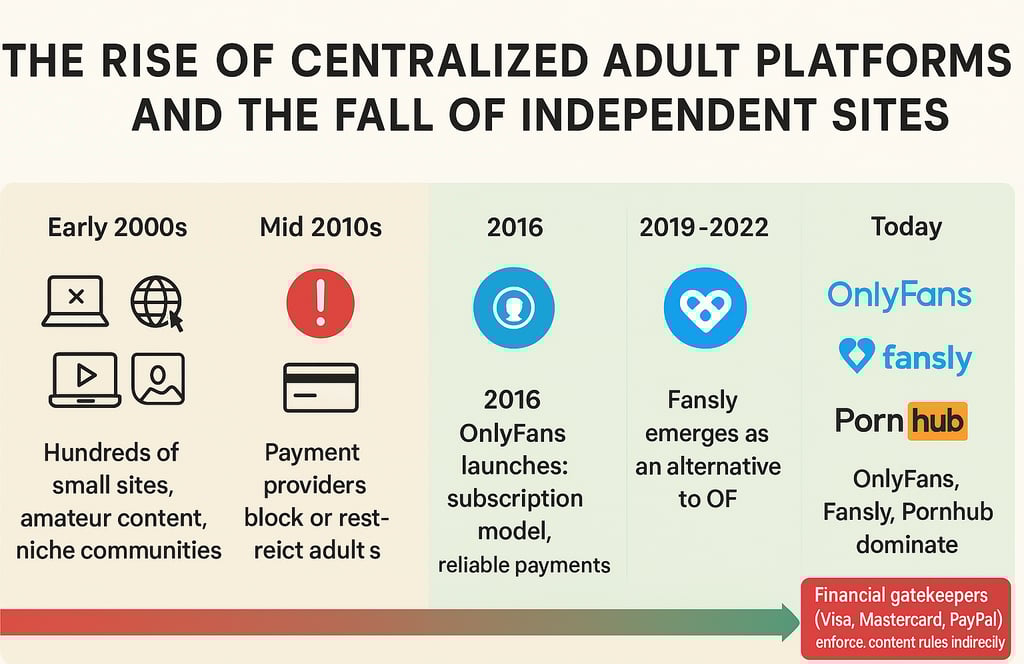
The Rise of Centralized Adult Platforms and the Fall of Independent Sites
Timeline / Flowchart Concept
1. Early 2000s – Independent Adult Websites
Hundreds of small sites, amateur content, niche communities
Revenue via subscriptions, ads, and PayPal/credit cards
Problem: Payment processors begin restricting high-risk content
2. Mid 2010s – Increased Regulation & Hosting Issues
Age verification laws start in EU/UK
Payment providers block or restrict adult sites
Small sites struggle to pay creators or survive
3. 2016–2018 – Rise of Subscription Platforms
OnlyFans launches (2016): subscription model, reliable payments
Creators migrate from small independent sites
Payment processors prefer a single platform handling compliance
4. 2019–2022 – Consolidation and Fansly Growth
Fansly emerges as an alternative to OF
Traditional independent adult websites mostly disappear
Centralized platforms dominate traffic and revenue
5. Today – Market Landscape
OnlyFans, Fansly, Pornhub dominate
Small niche sites exist, but centralization is clear
Financial gatekeepers (Visa, Mastercard, PayPal) enforce content rules indirectly
Conclusion
The shift from hundreds of independent adult websites to a handful of dominant platforms isn’t just a story of changing technology or taste. It’s a story of financial gatekeepers, risk management, and centralized power. Credit card companies, by choosing what transactions to allow, effectively decided which creators would thrive and which would vanish.
For anyone looking to understand the modern adult content landscape — whether creators, consumers, or industry watchers — it’s a crucial lesson: the platforms we use, the laws we follow, and the companies handling our money are all intertwined. And sometimes, the biggest power in the room isn’t a creator, a website, or even a social media platform—it’s the financial infrastructure behind the scenes.
© 2025. All rights reserved.
2608 Westgrove Dr #236, Carrollton, Texas 75006.
Email - info@manteasers.com